
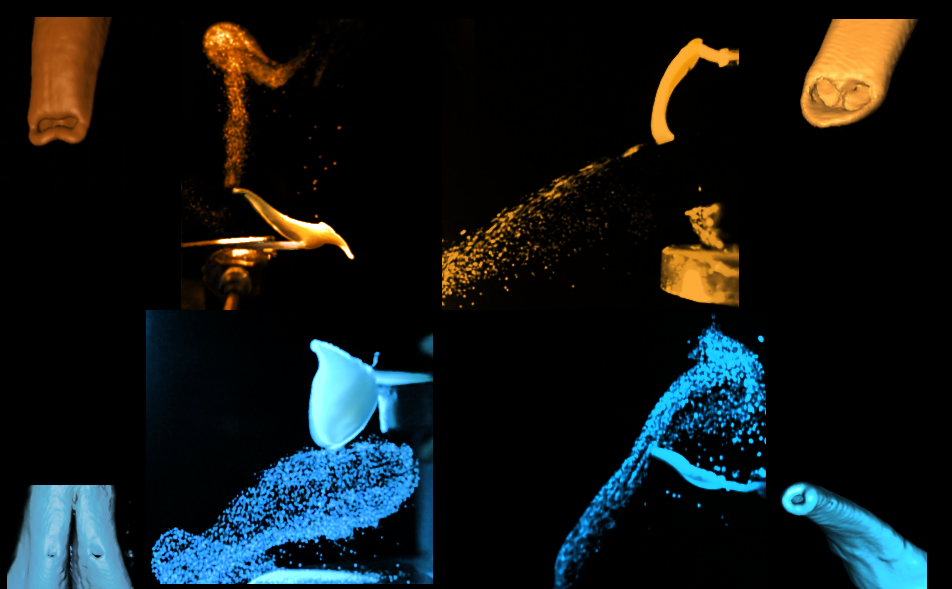
PhD student Ben Lazarus has been running many experiments on buzz-pollinated Melastomataceae flowers over the past three years, both in botanical gardens and the natural environment of these plants. Those experiments have made him travel to beautiful places in Colombia, Ecuador and Brazil where Melastomataceae are super diverse and visited by their natural pollinators – buzzing bees. Ben has been busy documenting bee-flower interactions and brought more and more equipment out to the field – including portable particle counters which allow us to quantify how much pollen gets released when we vibrate flowers, and high-speed cameras to better understand how buzz-pollination works. When bees buzz flowers, the entire action – landing, grabbing stamens, starting to shake them until they release pollen, pollen grains landing on the bees – takes place in just a few seconds or less. High-speed cameras help us break down these super short interactions into time units where we can analyse bee behavior and understand which component of the bee behavior is most important in causing pollen release and resulting in pollen deposition on the stigma. Importantly, buzz pollination is not only about how much pollen gets released – but also how pollen is released. And how pollen is released from the poricidal stamens depends a lot on stamen morphology – a discovery we recently published in the journal Nature Communications: https://doi.org/10.1038/s41467-026-76766-z
In the manuscript Scoop-shaped pores change how pollen is released from poricidal flowers, we explore how modifications of the stamen’s pore – specifically, a small, spathulate broadening around the pore area, making an anther look like a small spoon, changes how pollen is released. We had long known that some Melastomataceae species have these spathulate structures around there pores while others don’t, but had never looked into their functionality. Ben went ahead and complemented the many artificial vibration experiments he has been running (these are experiments where we mimick bees and replay artificially synthesized vibrations, transferring them to the stamens by clamping stamens with small metal tweezers attached to a vibration transduction speaker) with high-speed video recordings of the experiments. In doing so, he discovered that species with scoop-shaped pores shoot pollen into the air differently from speices lacking such scoop-shaped pores. Specifically, scroop-bearing species shoot out pollen faster and in more targeted, narrower jets – which should make pollen i) fly farther (e.g., to allow reaching a bee that is further away from the stamen) and ii) land on more discrete areas of the bee’s body. Species lacking such scoops, in contrast, scatter pollen in wider clouds. Although we have not yet tested the functionality of the “scoop-mechanism” in field studies, it should mean that scoop-bearing species may place pollen more accurately on bees, thereby possibly allowing them to reduce pollen wastage and increasing precision in the pollen transfer process. Importantly, although our main focus of study is the plant family Melastomataceae, scoops are not restricted to this family but occur widely across flowering plants – with the “scoop mechanism” working the same across all species we tested. Also, in scoop-bearing species, the functionality of the scoop is sensitive to variation in vibration profiles – it works well at frequencies of 300 Hz in Meriania speciosa (see video below), but breaks down at lower frequencies which bees can also produce, leading to widely scattered, continuous pollen release at low frequencies. As you can guess from this post – we are busy complementing these experimental results with more data from the field where we actually study bees in action to better understand how pore morphology affects pollen deposition precision and, ultimately, pollination success.