
Research
Pantropical pollination syndromes and floral evolution in Melastomataceae
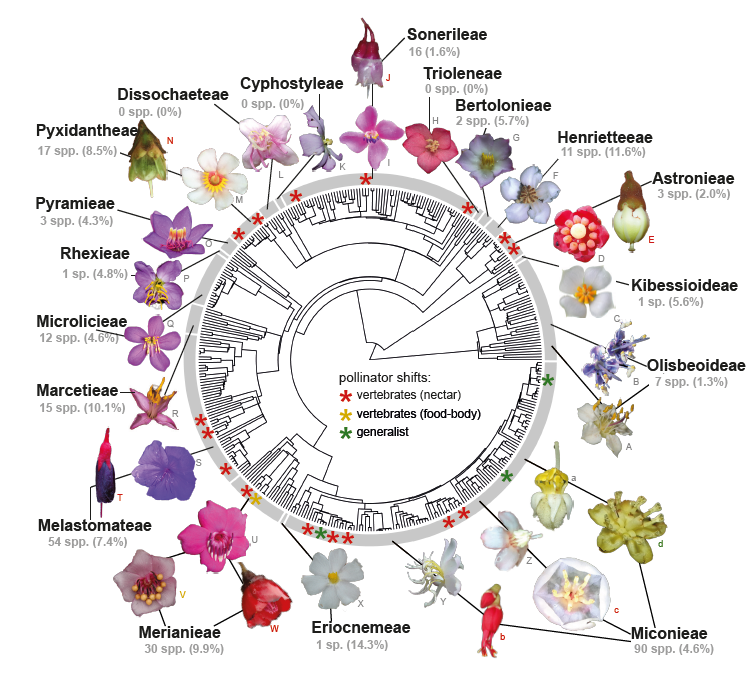 Despite decades of research on pollinator-mediated selection, the mechanisms and processes by which flowers evolve and diversify remain elusive. Are there floral traits which are evolutionarily more labile? Do certain floral traits evolve independently of other floral traits? And do some sets of traits evolve repeatedly and converge into pollination syndromes? Do developmental or functional constraints restrain flowers from converging into traditional pollination syndromes?
Melastomataceae harbour an exceptional diversity of different pollination strategies, but less than 300 species count with empirical pollinator observations. In recent projects, we focus on empirically documenting pollinators for more species across Melastomataceae, and collecting a detailed floral trait database for Melastomataceae, currently encompassing more than 450 species across the family, and both from Neo- and Paleotropical species. We use machine learning to predict pollinators for species hitherto unobserved in the field, and evaluate prediction accuracy by subsequent empirical observations when possible. We further use this dataset to address complex questions of floral trait evolution and large-scale patterns of trait-environment associations. Through collaborative efforts, we have further contributed to improving molecular phylogenies for the tribes Merianieae (which Agnes worked on during her MSc, PhD and postdoc) and Pyxidantheae. These varied data sources now allow us to study the evolution of Melastomataceae reproductive strategies both in light of pollination and the abiotic environment, test hypotheses on how shifts in pollinators affect population genetic differentiation, and explore the intertwined roles of geology, historic biogeography, abiotic climatic niche evolution and biotic interactions in driving lineage diversification.
Buzz-pollination and biomechanics in Melastomataceae
Buzz-pollination refers to a functionally highly specialized pollination strategy where bees apply vibrations to flowers to extract pollen rewards. Pollen is concealed in tubular anthers which only open by a small, apical pore. Buzz-pollination has evolved in more than 65 plant families independently and is considered as an evolutionarily highly successful strategy (adaptive plateau). Although Melastomataceae represent the largest radiation of buzz-pollinated flowers, functional aspects of buzz-pollination in this group remain poorly understood.
We have recently been funded by the Austrian Science Fund (FWF, 2023/03, project number P-36766) to investigate the structural and functional properties of buzz-pollinated Melstomataceae combining High-Resolution X-Ray Computed Tomography with structural analyses of stamens and artificial buzzing experiments in the field. We are working both at a comparative macroevolutionary as well as at a community level to test a variety of hypotheses on the adaptive success of buzz-pollination and how multiple, co-occurring buzz-pollinated Melastomataceae species partition the bee pollination niche. This project includes a new collaboration with Ernst Csencsics at the Automation and Control Institute at the Technical University of Vienna to approach the functioniong of flowers from a mechanical perspective.
Plant-animal interactions in an environmental and evolutionary context
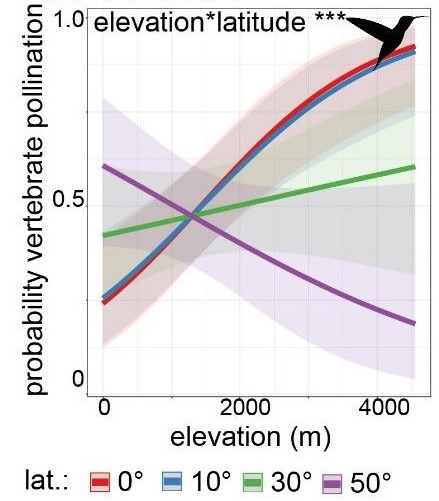
While the relation between abiotic environmental conditions and vegetative plant traits has been a central theme in plant ecology, how the structure and function of plant-animal interactions changes along environmental gradients is much less understood. Our investigations in Melastomataceae have demonstrated that evolutionary pollinator shifts were not a pre-requesite for mountain colonization, but likely a consequence of the reduced pollination efficiency of bees in the rough mountain climate.
Understanding whether there are general rules in how environmental factors drive pollinator shifts, under which conditions ancestral pollinators are retained, and how the abiotic environmental context modulates interactions also among co-occurring plants, are major themes in our reserach. Agnes has recently been funded through the European Research Council (ERC Starting Grant) to conduct a cross-continental comparative assessment of interaction dynamics between Melastomataceae flowers and their pollinators along four tropical elevational gradients. Read more about the project MountBuzz here.
Flower-fruit trait evolution and ecogeography
Although fruits develop from the ovary of flowers and are hence linked developmentally, these two major phases of angiosperm reproduction are commonly studied in isolation. Recently, we have teamed up with Miranda Sinnott-Armstrong to study the evolution and ecogeography of flower and fruit traits both across a wider sample of angiosperm species, and within Melastomataceae.
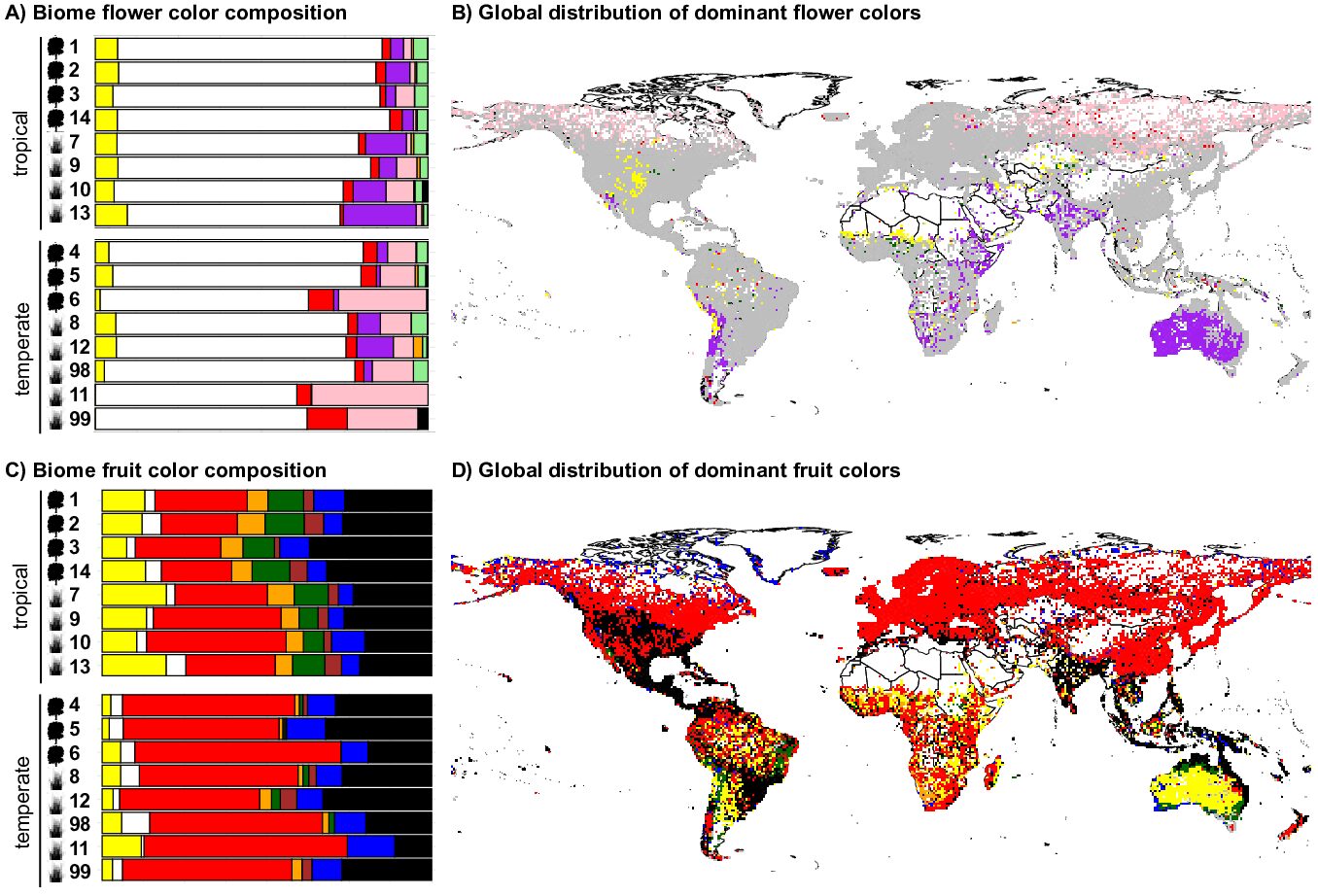
Focusing on flower and fruit color, we have found that flowers use fundamentally differnet colors than fruits, and that they differ in their geographic distribution – white flowers are common throughout, but pink flowers are more common in temperate environments, while yellow and purple flowers are more common in dry environments. Most red fruits are found in the temperate zone, while black fruits are common in tropical rainforests, and yellow fruits are common in warm, dry environments. Further, plant clades seem to invest into either diversifying their flower or their fruit colors, pointing towards exciting trade-offs, which we are investigating in ongoing projects.